Lorikeet Security: AI Alone Isn't Enough for Startup Defense
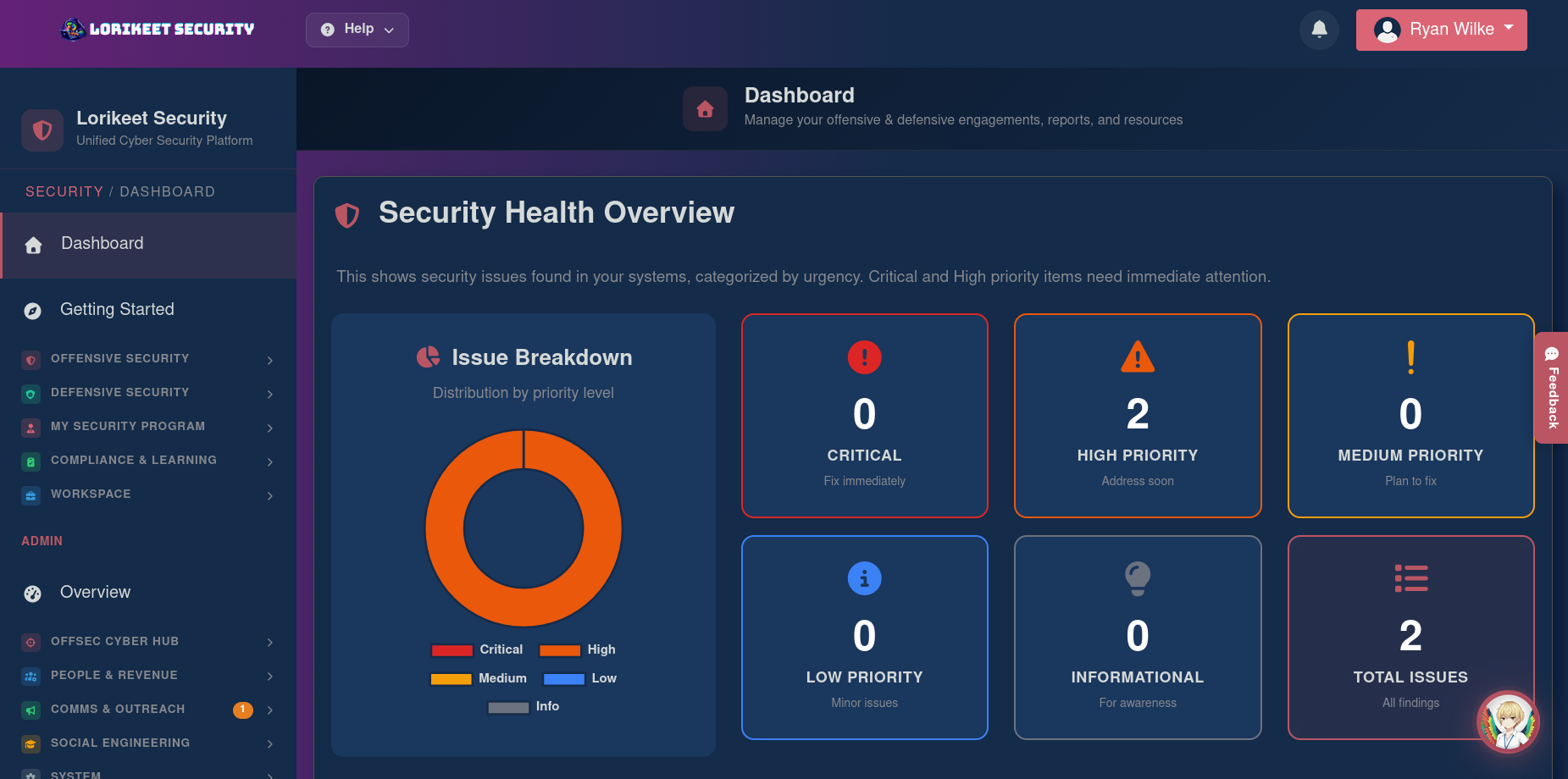
"AI closed half the easy bugs—what was left was the infrastructure."
Teams that add AI-assisted code review often cut routine source-level findings by roughly 50% — in my 15 years of watching startups scale, that statistic changes how you buy security. The Lorikeet Security case study with Flowtriq is the clearest technical example I've seen of AI + manual testing working together: Flowtriq ran a Claude-driven audit that eliminated XSS, SQLi, template injection and weak crypto in source. The subsequent manual pentest by Lorikeet Security still surfaced five additional findings (2 High, 1 Medium, 2 Low) in runtime and infra — session management edge cases, TLS posture at runtime, file-system hygiene, and reverse-proxy header configuration. This case is a playbook for AI-native engineering teams who want defensible, compliance-ready security without overpaying for noisy automation.
Architecture & Design Principles
Lorikeet’s platform is built as a PTaaS-first stack: a human-in-the-loop backend that pairs automation for reconnaissance and triage with manual offensive work for validation. The architecture appears to be a microservices-backed portal (real-time findings, chat, and reporting) over a multi-tenant backend that separates discovery (automated scanners, ASM) from exploitation and manual verification (operator workflows, ephemeral test environments). Key design decisions favor:
- Separation of automated vs manual phases so AI/automation reduces noise while human testers chase business logic and runtime flaws.
- Real-time comms (WebSocket or long-poll) and integrated reporting to compress the feedback loop to engineering teams.
- Secure, auditable data pipelines (RBAC, SSO, encrypted storage) to support compliance-heavy customers (healthcare, fintech, government). From a scalability POV they likely use queuing for scan jobs, autoscaled workers for active scanning, and container sandboxes for safe exploits — a pattern that lets boutique offensive teams scale without rearchitecting core pentest workflows.
Feature Breakdown
Core Capabilities
- Manual Web & API Pentesting: Deep, logic-aware testing that goes beyond static analysis. Use case: finding session fixation or token misuse that AI code scanning misses because the bug manifests only under specific runtime sequencing.
- Continuous Attack Surface Management (ASM): Automated discovery and monitoring of internet-facing assets with alerting and prioritized exposures. Use case: detect forgotten staging servers, shadow APIs, or supply-chain endpoints introduced by 3rd-party services.
- PTaaS Portal with Live Findings & Chat: Live triage, evidence playback, and QA dialogue between testers and engineers. Use case: product teams triage a “High” finding together, replay requests, and confirm fixes without Slack noise.
Integration Ecosystem
The platform provides APIs and webhooks for ticketing (create/update JIRA issues), CI/CD integrations (scan-on-merge hooks), SSO (Okta, SAML), and SIEM connectors. In practice, testers push verified findings directly into engineering workflows and can trigger re-tests via API—this reduces MTTR compared to traditional PDF pentest reports.
Security & Compliance
Lorikeet offers compliance-aligned testing (SOC 2, HIPAA, PCI-DSS, HITRUST, FedRAMP clients) and practitioner-built evidence packages. Data handling leans on client-scoped report encryption, time-limited artifact retention, and RBAC for engagement visibility—important for startups that need audit trails without handing over production keys.
Performance Considerations
Manual pentesting is inherently time-consuming, but Lorikeet's PTaaS portal offsets latency by parallelizing reconnaissance and human validation workflows. Automated scans and ASM run continuously and are low compute per asset; exploit validation is bursty and human-limited. Expect predictable queueing for in-depth manual tests and near-real-time updates for automated findings.
How It Compares Technically
While Flowtriq excels at network-level defenses—instant DDoS detection and auto-mitigation to protect availability—Lorikeet Security is better suited for offensive validation that targets runtime and configuration risks. Flowtriq’s strength is uptime protection and edge defenses (fast, automated mitigation, lower cost for that use case). Lorikeet’s differentiator is human-led discovery of logic and infra defects, deeper compliance evidence, and a PTaaS experience tailored to engineering teams that already use AI tools. For startups, the choice isn’t mutually exclusive: use Flowtriq for availability and Lorikeet for periodic offensive validation.
Developer Experience
The PTaaS workflow is designed for engineers: clear evidence (request/response captures), re-test hooks, and a chat interface to ask testers for reproductions or mitigations. SDKs and APIs for common platforms (GitHub, JIRA, Slack) are table stakes; quality comes down to how well the platform maps findings to remediation steps — on that front Lorikeet’s human reports and syntheses are superior to automated scanners’ noise.
Technical Verdict
Strengths: a pragmatic AI+human model that acknowledges AI will reduce trivial source-level findings but can’t replace manual testing of runtime, infra, and configuration. The PTaaS UX shortens remediation cycles and produces compliance-ready evidence. Limitations: manual pentesting is costlier and slower than pure automation; teams must budget for periodic deep tests as ASM and automation handle continuous monitoring. Ideal use cases: AI-native SaaS, fintech and healthcare startups preparing for audits (SOC 2/HIPAA), and any team that needs pragmatic, actionable offensive validation rather than raw CVE lists.
What others won't tell you: AI closes the low-hanging fruit, which changes the ROI calculus — manual pentests are no longer redundant; they’re the high-leverage investment that finds what automation structurally cannot. As a bootstrapped founder, pair targeted Lorikeet-style engagements with continuous ASM and frontline protections like Flowtriq to cover both availability and deep security assurance.
Resource Link
Visit Lorikeet Security Case Study →