How to Build an AI-Driven Startup Community Fast Using Heartbeat
Why community is the unfair advantage you’re probably underusing
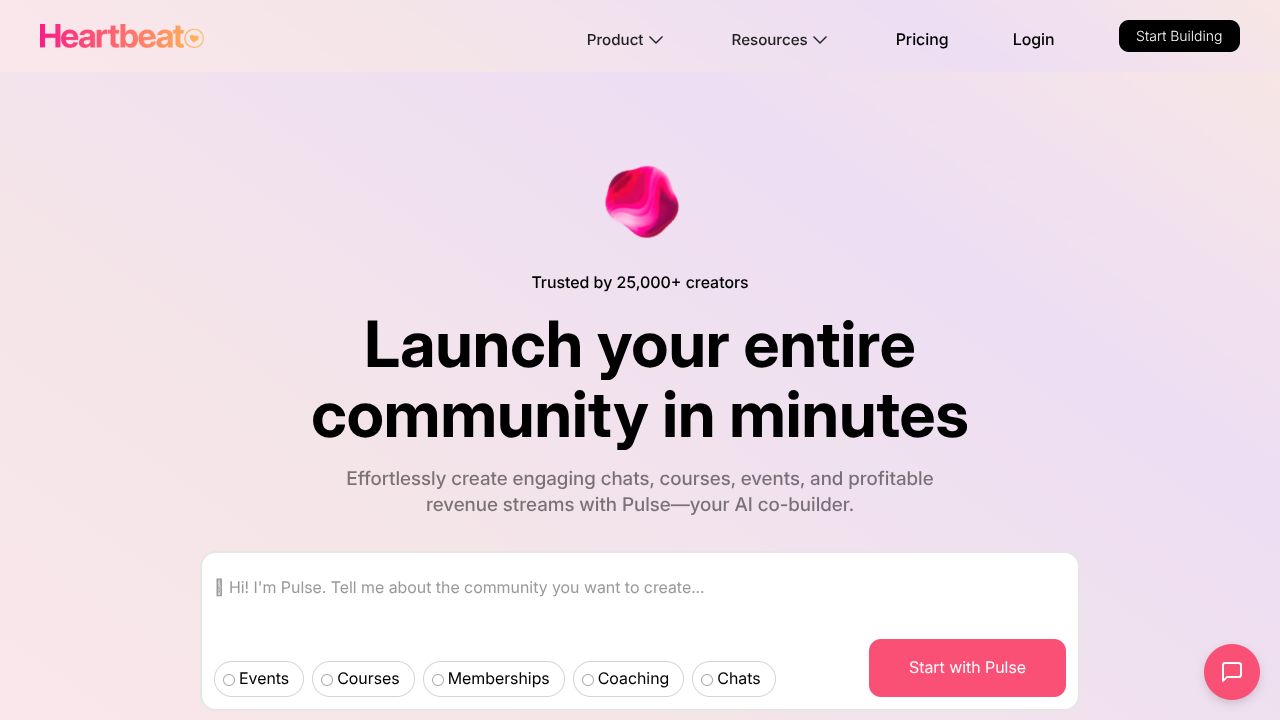
Creators who treat community as a channel report dramatically better retention and referral lift — in my 15 years advising startups I’ve seen founders turn a handful of superfans into the backbone of a business. Heartbeat (https://www.heartbeat.chat) is a cost-effective community platform built for creators and coaches who need AI-assisted growth without enterprise pricing. Compared to heavyweight players like Circle or Mighty Networks, Heartbeat’s selling point is automatic, AI-driven member pairings and simple white‑labeling at a fraction of the cost — perfect when you need scalable peer learning and masterminds, not a full engineering bet.
Step 1: Get your account live in 20 minutes
I recommend treating your first setup like a product launch sprint — fast, focused, iteration-ready.
- Sign up at Heartbeat and choose the plan that fits: start on the basic plan to pilot; upgrade to Growth when you need advanced automation and branding.
- Create your space: pick a name that matches your program or cohort. Keep it short and searchable.
- Configure branding:
- Upload your logo and color palette.
- Set a custom domain and email whitelabeling once you upgrade — this removes friction and increases trust during invites.
- Add an onboarding room and a welcome post that explains the pairing cadence and expectations (1–2 minutes to read).
- Invite your first cohort via CSV or invite links — seed with 10–50 members to get meaningful matchups.
Do this quickly and treat the first cohort as an experiment: iterate based on engagement metrics, not perfection.
Step 2: Core features that actually move the needle
Heartbeat packs several founder-friendly features. Use them deliberately.
- AI-powered member matchups
- How I use it: collect 3 quick interest tags in the onboarding form (e.g., “pricing,” “customer acquisition,” “fundraising”) and let the AI create weekly pairings or mastermind groups.
- Result: higher 1:1 conversations and accountability without manual matchmaking.
- Custom domains & email whitelabeling
- Why it matters: reduces “invite spam” skepticism and improves email deliverability for onboarding sequences.
- Points & badges system
- Practical example: award points for posting wins and badges for mentorship — tie this to visibility (spotlight posts) to reinforce behaviors.
- Automated workflows
- Use cases: auto-welcome messages, nudge sequences for members who haven’t posted in 7 days, and automated pairing reminders before each weekly session.
Step 3: Pro tips I give founders (what others won’t tell you)
These are the operational hacks founders rarely voice.
- Seed profiles before launch — fill out 5–10 “model” profiles that the AI can use to create richer matchups.
- Use short, predictable pairing cadences (weekly or biweekly). Too frequent and people burn out; too rare and momentum dies.
- Tie matchups to a micro-commitment: every pairing completes a 15-minute check-in and logs one action. Track completion as a KPI.
- Keep automation conservative. Over-automating communication makes communities feel robotic; use personalized templates with one human touchpoint per batch.
- Upgrade to Growth when you need domain/email whitelabeling or more complex workflows — until then, invest in onboarding copy and 1:1 support.
Common mistakes to avoid
- Overconfiguring before people arrive — launch a minimal structure, then iterate.
- Ignoring onboarding data — if you don’t ask about goals/interests, AI matchups are weak. Make 3 fields mandatory.
- Expecting engagement to self-start — schedule the first 3 pairing meetings for everyone and make attendance a norm.
How Heartbeat stacks up to other platforms
Heartbeat sits between lightweight options like Discord and feature-heavy platforms like Circle or Mighty Networks.
- Circle — richer integrations and customization, but higher cost and setup complexity. Heartbeat wins for cost and automated pairing.
- Mighty Networks — strong for courses and bundled memberships; better when you need a full “course + community” product. Heartbeat wins for masterminds and peer matching without the course overhead.
- Discord — free and flexible, but lacks built-in matchmaking and polished onboarding flows that creators need to scale responsibly.
(If you’re evaluating, prioritize the behaviors you need: 1:1 pairing and low-friction onboarding → Heartbeat; course + membership bundles → Mighty Networks; deep custom integrations → Circle.)
Conclusion: Who should pick Heartbeat?
In my experience, Heartbeat is ideal for bootstrapped creators, coaches, and early-stage founders who want AI-assisted peer learning and a professional look without enterprise cost. Start on the basic plan to validate your cohort cadence and onboarding, then move to Growth for whitelabeling and advanced automations once you have repeatable demand. If your product depends on high-touch cohort outcomes and repeatable peer accountability, Heartbeat will get you live fast and scale affordably — which is the kind of leverage every indie founder needs.
Resource Link
Visit Heartbeat →