How Fast Can You Mitigate DDoS Attacks Without Breaking the Bank?
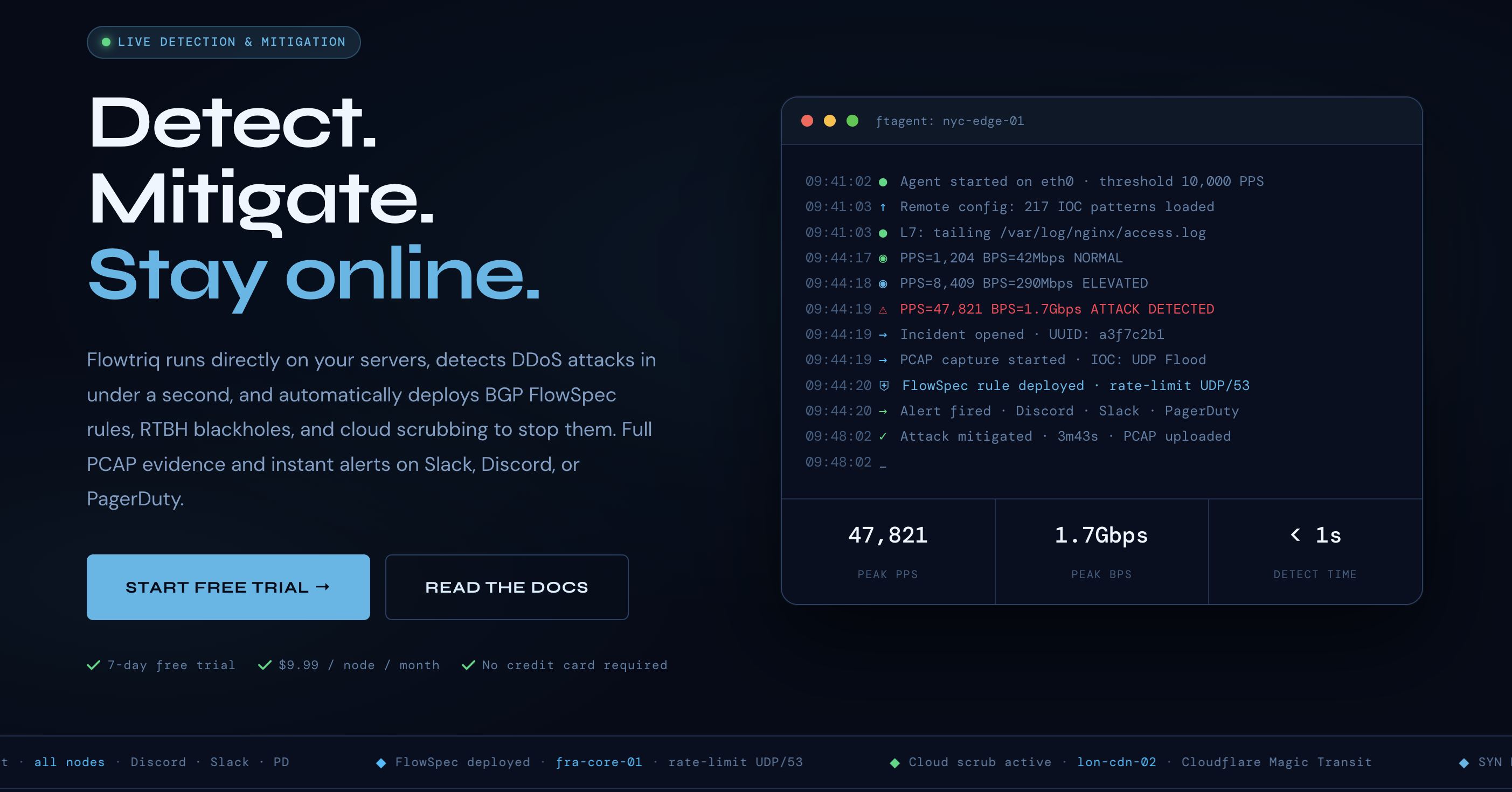
Most DDoS defenses make you complacent. Here’s one that forces your ops to get faster.
Flowtriq is an agent-based, real-time DDoS detection and auto-mitigation platform that sits on your Linux hosts and acts in under one second to stop attacks before users notice. For bootstrapped founders and infrastructure leaders, that speed + low predictable pricing matters because it protects revenue and reputation without adding opaque per-GB bills. Bottom line: Flowtriq is a lightweight host-first defense that lets lean teams punch above their weight in DDoS resilience.
The Business Case
In my 15 years advising startups and scaleups, downtime and slow mitigation are the silent margin killers: lost conversions, SLA credits, churn, and the PR damage that follows. Flowtriq addresses that by detecting packet-level anomalies at sub-second cadence and auto-deploying mitigations (BGP FlowSpec, RTBH, or cloud scrubbing) based on policies you control. The economic math is straightforward for small operators — $9.99/node/month (annual discount available) with no traffic surcharges means predictable OPEX versus variable egress fees from cloud scrubbing alone.
Operational ROI shows up in three places: reduced Mean Time To Mitigate (MTTM), reduced customer support load during incidents, and fewer transactional losses during attacks. For hosting providers, game studios, and SaaS platforms where user experience is directly tied to revenue, shaving even one minute off mitigation can be the difference between a minor blip and a major outage. Flowtriq’s published research and free tooling (BGP FlowSpec builder, PCAP analyzer) also reduce the time your team spends building homegrown defenses — a practical advantage for bootstrapped teams.
Key Strategic Benefits
-
Operational Efficiency: The ftagent installs in minutes and begins learning baselines immediately. That host-level visibility eliminates blind spots between edge scrubbing and origin servers and automates the tedious escalation steps that usually slow down mitigation.
-
Cost Impact: Predictable per-node pricing removes the surprise of per-GB scrubbing bills and helps you model worst-case costs into unit economics. For SMB operators, the alternative is often expensive over-provisioning or ad hoc third-party scrubbing contracts.
-
Scalability: Flowtriq’s central dashboard and multi-node management let you scale protections as you add nodes or edge sites. Hybrid mitigations (FlowSpec + cloud scrubbing) make it practical to protect distributed fleets without centralizing all traffic.
-
Risk Factors: Don’t underestimate operational dependencies — BGP FlowSpec and RTBH require ISP/peer support and correct routing controls. False positives at the host layer can disrupt legitimate traffic if escalation policies aren’t tested. Also note Linux-only agent support and the need to manage PCAP retention (Enterprise tier required for 365-day storage).
Implementation Considerations
Technically, installation is trivial — under two minutes per host — but operational rollout needs structure. I recommend a phased pilot: pick 3–10 representative nodes (edge web, game server, API gateway), install ftagent, and run a simulated attack workflow. Key integrations to pre-flight: BGP credentials with your upstreams (confirm FlowSpec/RTBH support), alerting endpoints (Slack, PagerDuty), and cloud scrubbing contracts if you’ll escalate off-host. Build and test automated playbooks so mitigations chain reliably and capture PCAPs for forensic readiness.
Expect a 1–4 week delivery cadence: days to install and baseline, a week to validate mitigations and alerts, and up to a month to train SREs and update runbooks. For multi-tenant hosts and MSSPs, add stakeholder sign-offs and legal review for automated blackholing/flow rules. Finally, instrument KPIs (MTTM, user-facing error rates, support tickets) so you can quantify impact within 30 days.
Competitive Landscape
Flowtriq occupies a different niche than edge-centric scrubbing providers. Cloudflare Magic Transit (https://www.cloudflare.com/products/magic-transit/) and AWS Shield (https://aws.amazon.com/shield/) are heavyweight, globally distributed scrubbing layers that excel at massive volumetric attacks but typically involve traffic routing and possible per-GB economics. Akamai’s Kona (https://www.akamai.com/products/security/kona-site-defender) and Imperva DDoS Protection (https://www.imperva.com/products/ddos-protection/) offer mature managed services with deep edge visibility. Netscout/Arbor (https://www.netscout.com/arbor-ddos) targets service-provider scale. What others won’t tell you is that edge providers often hide complexity and billing variability; Flowtriq’s host-based approach is complementary — you can stop attacks close to the source and only escalate to scrubbing when needed, reducing reliance on costly routing changes.
Recommendation
If you run customer-facing infrastructure with tight margins, I recommend a 30-day pilot: deploy ftagent on 3 critical nodes, enable automatic playbooks with Slack/PagerDuty alerts, and coordinate with your upstreams for FlowSpec/RTBH support. Measure MTTM, support tickets, and conversion impact. If you manage 50+ nodes or need extended forensics, evaluate the Enterprise plan. Protecting user experience cheaply and predictably is a rare lever — use it.
Resource Link
Visit Flowtriq →